Choosing Right Air Filters: Technical Selection Criteria
In summary: Selecting a replacement air filter requires more than matching physical dimensions. The process involves evaluating filtration efficiency ratings, dust holding capacity (DHC), and initial restriction levels to ensure the engine operates within its designed volumetric efficiency parameters. Choosing right air filtration components is essential for preventing premature wear on cylinder liners and turbocharger compressors.
Why is filtration efficiency critical for engine longevity?
The primary function of an air filter is to capture abrasive particles before they enter the combustion chamber. Modern internal combustion engines are highly sensitive to particulate matter, particularly silica and carbon. Efficiency is typically measured according to the ISO 5011 standard, which determines the percentage of dust retained by the filter. Technical specifications often distinguish between initial efficiency and full-life efficiency. As a filter accumulates dust, its efficiency actually increases because the dust layer itself acts as an additional filtering medium. However, this comes at the cost of increased flow resistance.
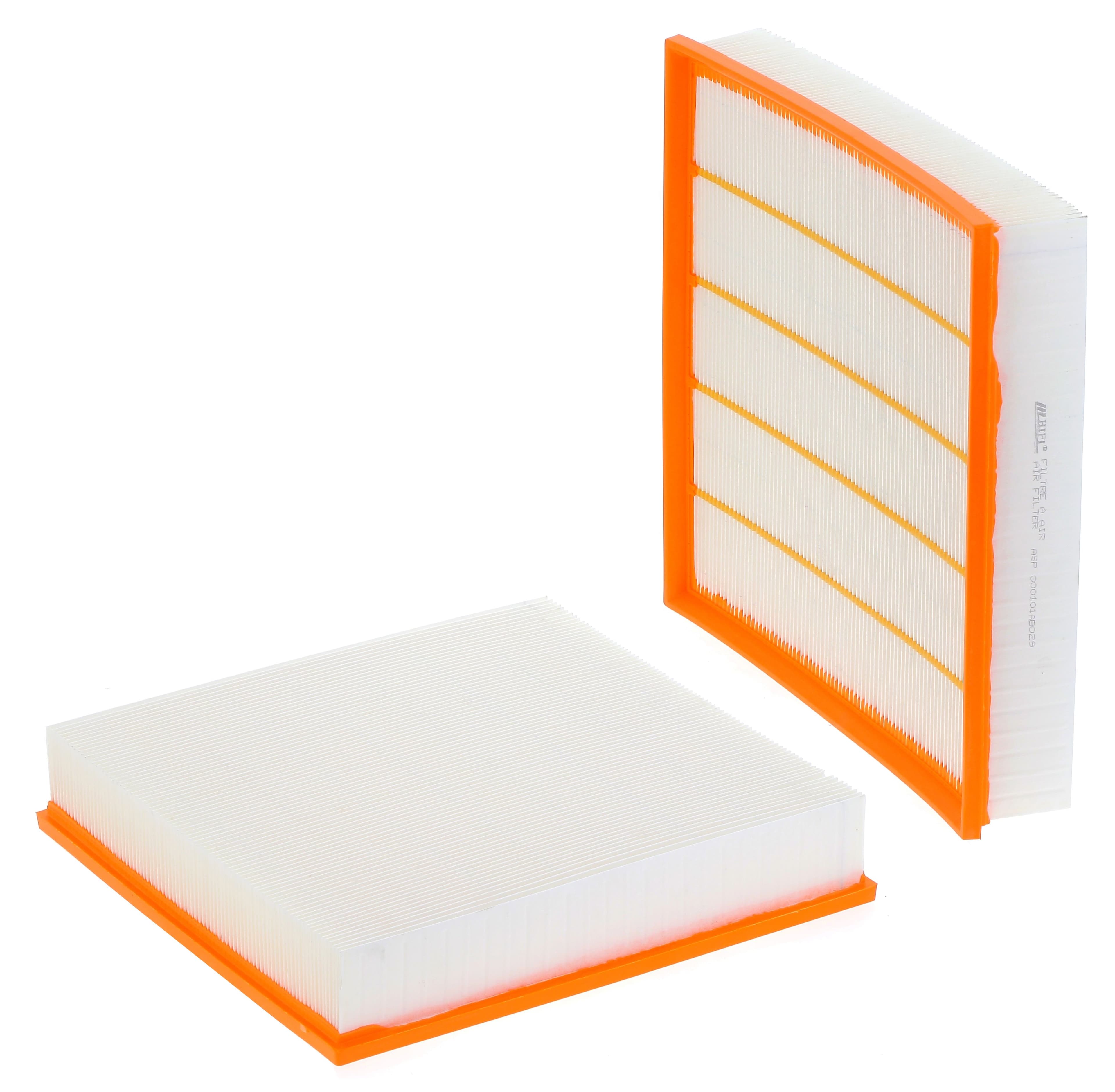
High-quality elements, such as the HIFI FILTER ASP 000101AB029, are designed to maintain a high Beta ratio, ensuring that even sub-micron particles are captured. If a filter lacks the necessary efficiency, microscopic debris can bypass the media and mix with the engine oil, creating an abrasive paste that rapidly wears down piston rings and bearings. For industrial applications, reaching an efficiency of 99.9% is often the benchmark for heavy-duty protection.
How does pressure drop affect choosing right air filters?
Pressure drop, or intake restriction, is the difference in air pressure between the clean and dirty sides of the filter media. Every engine has a maximum allowable restriction limit, usually measured in kilopascals (kPa) or inches of water (H2O). When choosing right air components, one must consider the volumetric flow rate required by the engine at maximum RPM. If a filter is too restrictive, the engine will suffer from a lack of oxygen, leading to incomplete combustion, increased exhaust gas temperatures (EGT), and significantly higher fuel consumption.
A technical evaluation must consider the 'initial restriction'—the pressure drop when the filter is brand new. Using an undersized element or one with poor permeability can lead to the premature triggering of the restriction indicator. This is why cross-referencing specific parts like the HIFI FILTER ASP 000201AA006 is vital; these components are engineered to provide a specific surface area that matches the air intake requirements of compatible machinery, keeping the restriction within the manufacturer's tolerances for the entire service interval.
What role does media surface area play in capacity?
The dust holding capacity (DHC) of a filter is directly proportional to the effective surface area of the media. This is achieved through pleating. The depth, count, and spacing of these pleats determine how much contaminant the filter can store before reaching the maximum allowable restriction. If the pleats are too close together (pleat bunching), the effective surface area is reduced because air cannot flow between the folds. This leads to rapid clogging and frequent service intervals.
Technical editors often look for features like pleat stabilisation, where beads of adhesive or synthetic backing prevent the media from collapsing under high vacuum loads. For instance, the HIFI FILTER ASP 000201AG006 utilises advanced geometry to maximise the media available within a compact housing. In heavy-duty environments, such as construction or agriculture, a higher DHC is non-negotiable. Using a filter with lower capacity than the OEM specification will result in increased maintenance costs and potential downtime, even if the filter fits the housing perfectly.
How should environment dictate filter selection?
The operating environment is a decisive factor in selecting the correct filtration media. Standard cellulose media is effective for road-going vehicles but may fail in high-humidity or extremely dusty conditions. Cellulose fibres can swell when exposed to moisture, significantly increasing restriction. In such cases, choosing right air filters involves looking for media treated with hydrophobic resins or synthetic nano-fibres.
Two-stage filtration systems are common in industrial settings. These consist of a primary element and a safety element. The primary element, such as the HIFI FILTER ASP 000301AA001, handles the bulk of the contaminant load. The safety element remains in place during primary filter changes to prevent dust from entering the intake while the housing is open. In extremely dusty environments, pre-cleaners or cyclonic separators are often used to remove larger particles via centrifugal force before they ever reach the primary filter media, thus extending the life of the main element.
What are the risks of incorrect physical dimensions and sealing?
Even the most advanced filtration media is useless if the seal between the filter and the housing is compromised. There are two primary types of seals: axial and radial. Axial seals rely on a gasket being compressed against the end of the housing by a lid or wing nut. Radial seals, found in modern designs like the HIFI FILTER ASP 000204AA011, use a flexible urethane end cap that slides over a tube in the housing, creating a seal through lateral tension. Radial seals are generally more reliable in high-vibration environments as they are less prone to loosening over time.
When choosing right air filters, precise dimensions are mandatory. A discrepancy of just a few millimetres can allow 'unfiltered air bypass.' This is a condition where air takes the path of least resistance around the filter rather than through the media. Even a 1% bypass can lead to engine failure in a matter of hours in dusty conditions. Technical specifications must be verified against the engine manufacturer's housing dimensions, ensuring that the gasket material (typically nitrile or polyurethane) is compatible with the expected temperature ranges. Using a part like the HIFI FILTER ASP 000205AA011 ensures that the structural integrity of the frame and the elasticity of the seals meet the required industrial standards.
Frequently asked questions
How do I know if a filter is compatible if the OEM number is missing?
If the original equipment manufacturer part number is not available, you must measure the outside diameter, inside diameter, and height of the existing filter. Additionally, identify the seal type (radial or axial) and the material of the end caps. This data can be used to search technical catalogues for a matching specification.
Can I clean a dry air filter with compressed air?
It is generally not recommended for modern high-efficiency filters. Compressed air can easily create microscopic tears in the media (pinholes) which are invisible to the naked eye but allow large particles to pass through. Cleaning also does not remove deeply embedded particles, meaning the filter will reach its restriction limit much faster after the second use.
What does a restriction indicator actually measure?
A restriction indicator measures the vacuum level in the air intake pipe between the filter and the engine. As the filter clogs, the vacuum increases. The indicator is calibrated to trip at the specific point where the engine's performance would start to be negatively impacted by a lack of air, signaling that a replacement is required.
Share